

Note: This is the second installment in a three-part series on the wrongful conviction of Jimmie “Chris” Duncan. You can read Part One here. Some of this story appeared in The Cadaver King and the Country Dentist, the book I co-wrote with Tucker Carrington. Some is material that was cut from the book for length. All of it draws from my own work over the past 20 years, including new reporting.
This series includes descriptions of alleged sexual abuse of a toddler as well as images that some readers may find disturbing, including post-mortem photos and video. I’m publishing this material because it is critical to the story.
If you’d like to contribute to help Duncan rebuild his life, you can give to his GoFundMe here.
1
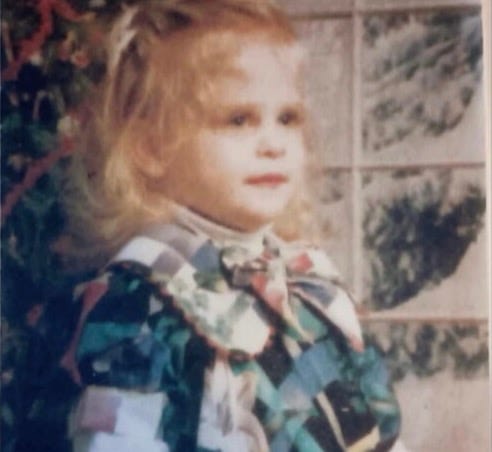
When District Attorney Jerry Jones sent Haley Oliveaux’s body to Steven Hayne, it was something of an audition. By the time of the child’s death in West Monroe, Louisiana in late 1993, Hayne was already doing nearly all the criminal autopsies for most of Mississippi. Now he was trying to expand into Louisiana too.
Jones, whose jurisdiction included Louisiana’s Ouachita Parish, suspected that Haley had been murdered by her mother’s boyfriend, Chris Duncan. Hayne would help Jones convict Duncan. And within two years, he would be doing all of the parish’s autopsies in criminal cases.
Accompanying Haley’s body to Mississippi in December 1993 was the West Monroe police chief, a detective, a police captain, and two assistant district attorneys. At least two of those officials sat in on the autopsy — an early red flag. The National Association of Medical Examiners strongly discourages pathologists from even speaking with law enforcement before conducting an autopsy other than to get basic information. Doing so can bias an examiner’s conclusions.
Haley’s autopsy took place one week before Christmas. During his initial examination, Hayne said he found fingernail scratches and bruises on her head, face, and neck. He also discovered severe injuries to her anus. Emergency room doctors had been startled by the anal injuries. A pediatrician would later tell the jury they were among the worst he’d ever seen.
According to Hayne, all of this supported the theory that Haley had been murdered. So did the fact that the child had a torn frenulum — the skin that connects the upper lip to the gums. This, he would say, was consistent with someone pushing her head into the floor of the bathtub to drown her.
Finally, Hayne said he noticed what looked like bite marks — injuries that had gone overlooked both by emergency room doctors and the Ouachita Parish coroner. To confirm his suspicions, he recommended that Jones bring in Hayne’s business partner, Michael West.
Jones swiftly got a warrant to obtain a mold of Duncan’s teeth, which was done that same day. Later that evening, West undertook his own examination of Haley while an assistant recorded with a video camera.
The footage is both astonishing and difficult to watch. It opens with Haley’s body lying on a metal autopsy table. A red block under her shoulders elevates her chest, while her head tilts backward and her arms hang off to the side. Fine strands of blonde hair fall away from her face, exposing her right cheek, the right side of her forehead, and her hairline. West announces the date and time: December 18, 1993, 9:35 pm.
The video shows light bruising around Haley’s ear and right eye, but there are no apparent cuts or abrasions on her face. The skin on her right cheek is smooth and unblemished.
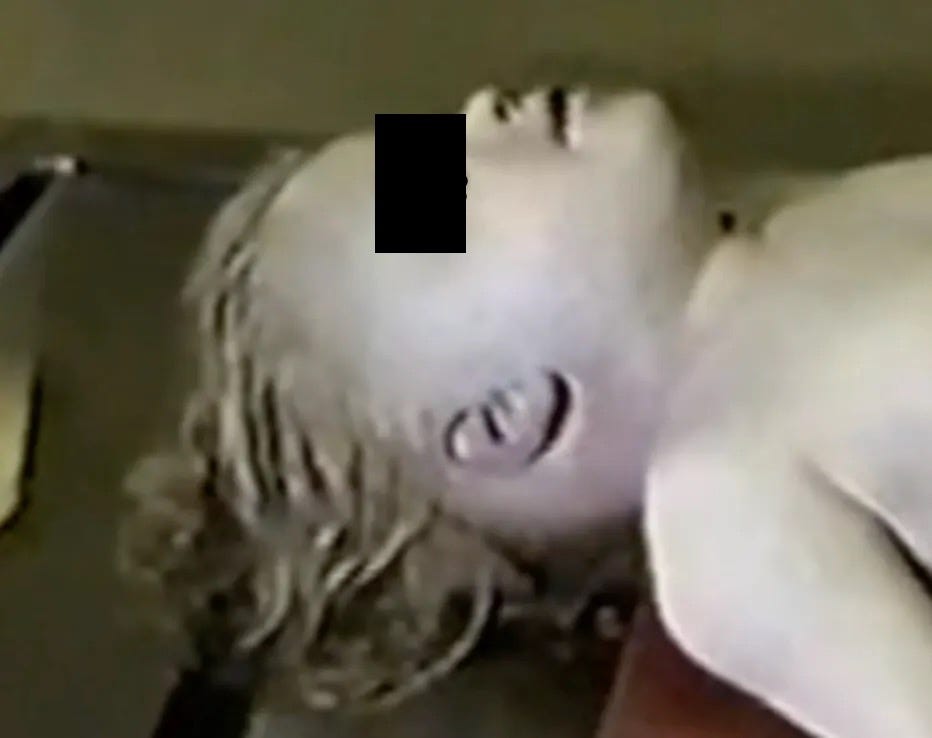
At the 4:57 mark, the video cuts out. When it resumes, it’s the following morning, December 19th. As the camera pans to Haley’s face, a striking detail comes into focus: Where there were previously no blemishes on her face, now there’s a conspicuous, arched abrasion on her right cheek. It looks a lot like a human bite.
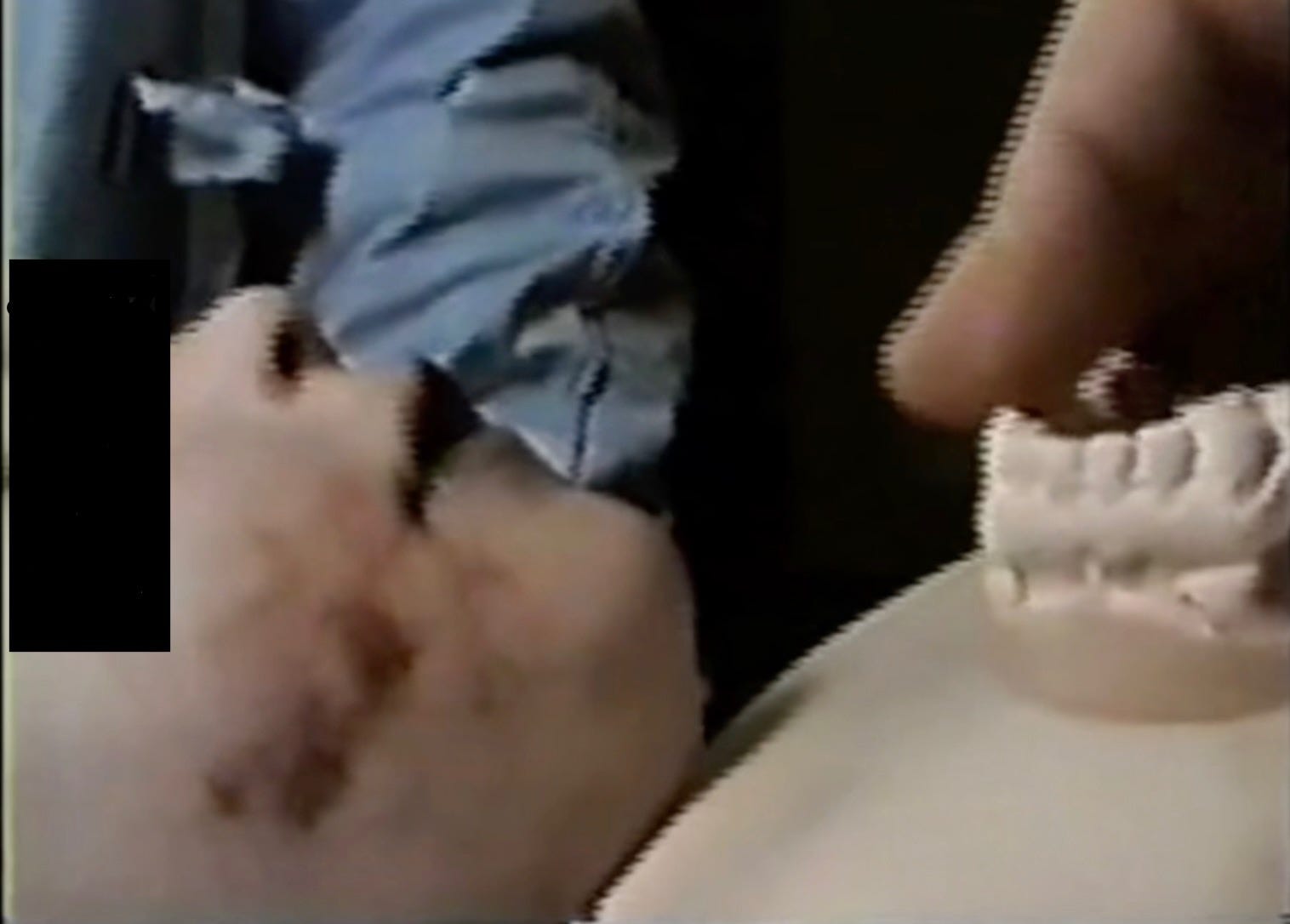
West’s hand then enters the frame. It is clutching a plaster mold of Duncan’s teeth. West repeatedly presses the top of the dental mold directly into the mark on Haley’s cheek. Over the next two minutes, West does this 17 more times. At the 6:57 mark, he drags the mold across her face. He begins near her lips, then scrapes the plaster teeth down to her jaw. He does this for another minute, then moves to the girl’s elbow. This time he uses the cast to push Duncan’s mold onto an existing bruise.
At the 9:32 mark, West asks someone to turn off the lights. The room goes dark and a fluorescent black light flickers on. The Mississippi dentist is now deploying “the West Phenomenon,” the technique West invented to find marks on human skin that no one else can see. With the lights out, West continues to jam the plaster cast into Haley’s cheek, elbow, and arm.
The video lasts a total of 24 minutes. In that time, West pushes, drags, or scrapes the cast of Duncan’s teeth over, on, and into Haley’s flesh at least 50 times.
NBC News report featuring clips of West using Chris Duncan’s dental mold on Haley Oliveaux
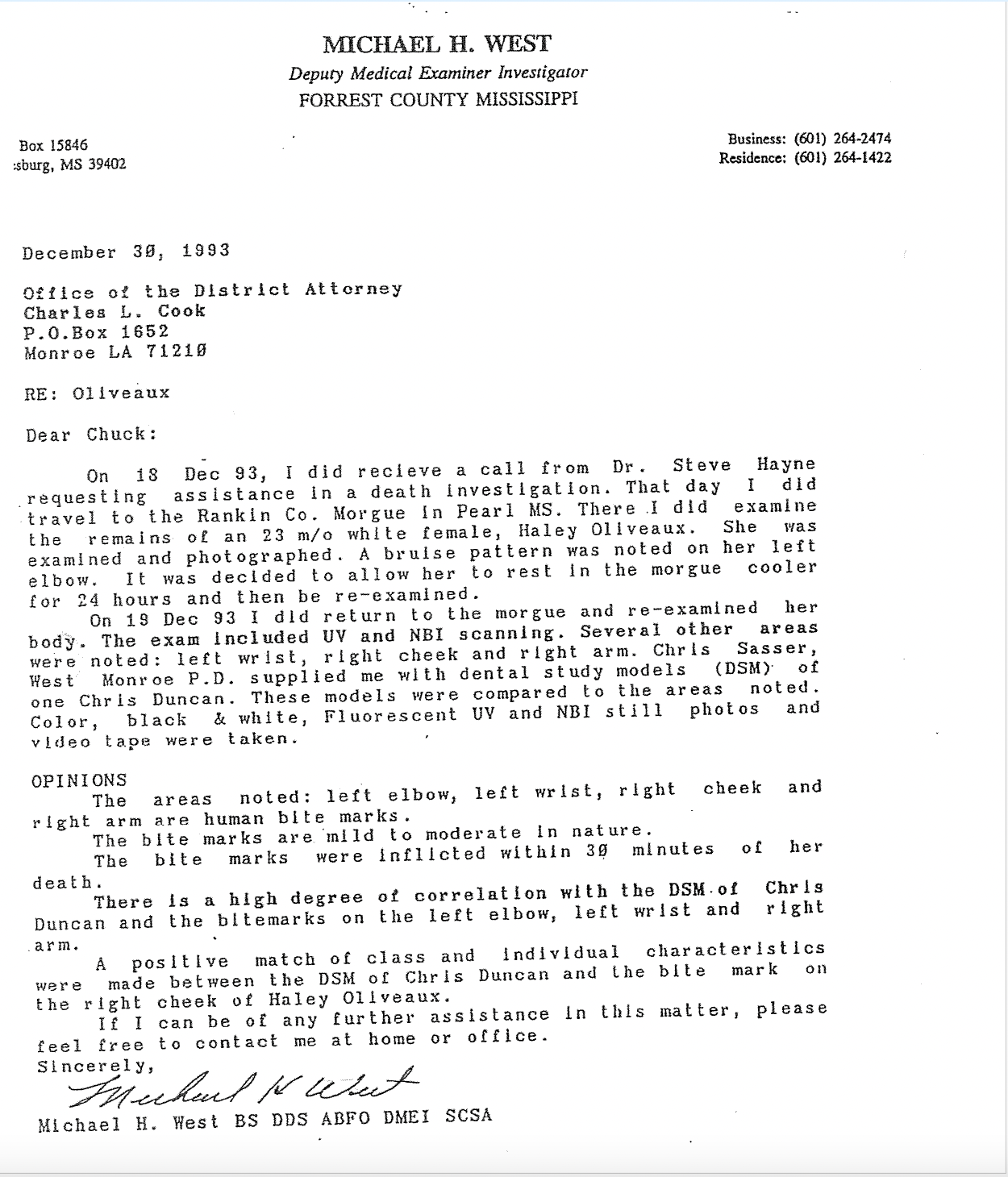
After completing his exam, West sent a letter to the DA. He told Jones that the suspected bite marks were indeed human bites and that they’d been inflicted within 30 minutes of Haley’s death. The injuries on her elbow and ear were “consistent” with Duncan’s teeth, he wrote, while the mark on her cheek was also a “positive match.”
Prior to West’s exam, Duncan had been charged with negligent homicide for leaving Haley alone in the bath. Armed with Hayne and West’s findings, Jones raised Duncan’s criminal charge to capital murder.
The state’s narrative was the stuff of nightmares. Prosecutors would argue that Duncan waited for Haley’s mother to go to work, then put the girl in the tub, where he viciously raped her, bit her, and pushed her head into the floor of the tub. Jones would tell jurors that Duncan “rode her like a bull,” then drowned her to silence her cries. While Duncan waited for Haley to “bleed out,” he went across the street to buy a pack of cigarettes, calmly exchanging hellos with a neighbor along the way.
When Duncan returned to the house, the state’s theory went, he drained the bathtub and cleaned up the blood, leaving no trace of evidence. He wrapped Haley’s lifeless body in a towel and took her to the neighbors’ house, where he put on a dramatic performance and sobbed hysterically as they tried to revive her.
On December 21, Jones announced that he would be seeking the death penalty.
2
Duncan couldn’t afford to hire a lawyer, so the Louisiana Indigent Defense Board appointed attorneys John Focke and Peter Edwards to represent him. Both were private lawyers who had contracts with the board to take cases, but neither was qualified to handle a death penalty case.
At their first meeting, Duncan gave Focke his account of what happened on the day Haley died. After Haley’s mother, Allison Statham, left for work, Duncan made Haley some oatmeal for breakfast. He then put her in the bath while he did some chores. When he went to check on her, he found her face down in the water.
But Duncan says Focke didn’t seem to believe him. In subsequent conversations, Focke grew increasingly irritated. “He was getting real sharp towards me, the way a parent gets with a child who keeps lying to them,” Duncan recalls.
Duncan finally asked Focke why he was being so brusque. “He just snapped at me and said he couldn’t represent me if I kept lying to him,” he says. “When I asked him what he thought I was lying about, he said, ‘Look, I’ve seen the bite marks. I’ve seen the pictures.’”
Duncan was confused. This was the first he’d heard of any bite marks. He told Focke he didn’t know what he was talking about. “Focke had this response like, ‘You’ve got to be real about this. You can’t be lying to me.’”
When they met again, Focke showed Duncan a photo taken after West’s exam, which depicted a clear bite mark on Haley’s cheek. Duncan was shocked. The police who interrogated him had shown him Polaroids of Haley taken at the hospital shortly after she died. The mark didn’t appear in any of them.
“There were two sets of photos,” Duncan says. Focke wasn’t aware of the Polaroids without the bite mark taken before West’s exam, and Duncan wasn’t aware of the photos with the bite mark taken after. Duncan had no idea how the bite mark appeared on Haley’s cheek.
“I said, ‘no, no, no, no, no, no. You’ve got to see the Polaroids from the hospital,’” he says.
Focke was floored, too. If what Duncan told him was true, it cast significant doubt on the state’s murder charge. It also suggested something far more sinister.
Focke needed to get the hospital photos, but he told Duncan he couldn’t let prosecutors know why he wanted them. If they knew how badly the photos could undermine their case, they may not turn them over. The photos might even go missing. So rather than go through Jones’s office, Focke reached out to West Monroe Police Detective Chris Sasser directly, and asked him to bring any photos of Haley to Duncan’s next pretrial hearing.
When Sasser took the stand at that hearing, Focke asked him for the photos he had brought to court. Sasser gave Focke a file folder, which Focke took to the defense table. Looking through the photos, “his eyes got wide,” Duncan recalls. Focke immediately asked the judge to enter the photos into evidence.
“I don’t think he believed me until he saw those photos in court,” Duncan says. He remembers Focke approaching him after the hearing with tears in his eyes. “He said, ‘We’re gonna deal with this.’ I could tell he felt bad for not hearing me. For not believing me.”
At about the same time, in February 1994, Duncan’s attorneys asked the state crime lab for the toxicology reports on the blood taken from Haley after she died. This was a routine request, part of any basic investigation into a client’s case. Haley had a history of seizures, which made Duncan’s lawyers suspect she may have suffered a seizure in the bath and drowned. A blood test could offer more insight into that possibility. It could also reveal any medication in her system.
They were stunned by the response. Not only had Hayne failed to order toxicology testing, the crime lab had somehow stored Haley’s blood samples with samples from DUI cases. They had since been destroyed. It’s not entirely clear how this happened. But several forensic labs would later say that Hayne often mishandled or mislabeled samples before sending them for analysis.
As Focke and Edwards continued to investigate Duncan’s case, they also learned more about Hayne and West. They reached out to George McCormick, the medical examiner who had previously done autopsies for Ouachita Parish, and who had been assembling a dossier on Hayne after hearing complaints from other pathologists. McCormick told the defense attorneys that Hayne had never been certified in forensic pathology by the American Board of Pathology, that he did way too many autopsies, and that he had a reputation for being sloppy. He also told them that Hayne rarely created tissue slides, which prevented other experts from reviewing his work.
“West didn’t take any photos of the alleged bite. He’d later say he was too tired to get out his camera.”
McCormick offered to review Hayne’s autopsy of Haley and waive his usual fee — but only if Duncan’s lawyers could get her body exhumed. He refused to do any analysis based on Hayne’s report. He didn’t trust Hayne to do a proper autopsy.
Duncan’s attorneys first turned to Statham, Haley’s mother, and asked for permission to exhume the child’s body. She refused.
She now says she regrets that decision. “I wish so much that I had let them do it,” she says. “It hurts to think that if I had given them permission it might have stopped Chris from spending all this time in prison. But back then everyone was lying to me.”
Without Statham’s permission, the lawyers would need a court order. So in March 1994, Circuit Court Judge Charles Joiner held a hearing to determine whether Haley should be exhumed.
Hayne and West themselves had repeatedly been granted exhumations in other murder cases. But those were at the request of the prosecution. Still, Duncan was facing the death penalty. Even if a credible medical examiner had done the autopsy, it shouldn’t have been an issue for Duncan’s own expert witness to examine the body. Yet the hearing turned into a debacle.
Under direct questioning by Duncan’s lawyers, McCormick brought up Hayne’s lack of board certification, the fact that he often didn’t create tissue slides, and the unscientific testimony he’d given in court. He also cited cases in which Hayne had made egregious errors. In one, Hayne had recorded the weight of the internal organs of the deceased. A subsequent autopsy found that those organs hadn’t been touched. McCormick also said other medical examiners told him that Hayne had claimed to review tissue slides they’d never sent him.
But on cross-examination, Jones attacked McCormick’s credibility. He portrayed the doctor as a man obsessed with bringing down a rival who had taken a large chunk of his business. Jones also confronted McCormick with some of his own mistakes. Hayne’s massive workload, sloppiness, and unprofessionalism were muddied into a narrative about two medical examiners with a personal beef.
Jones seemed particularly concerned with the injuries documented by Hayne and West. Wasn’t it true, he asked McCormick, that such marks were likely to be altered — or to disappear — when a body was embalmed or as it decomposed? And, if that was the case, wouldn’t it be prudent to rely on photographs of the marks rather than what someone might find on Haley’s exhumed body? McCormick conceded both points.
Of course, the photos Jones was talking about had been taken after Hayne and West examined Haley. They showed injuries West himself created on the girl. Jones knew this. He had seen West’s video by then. And he had kept it from the defense.
McCormick was unaware of the video. If he had known about it, he likely would have said that it would be wrong to rely on the photos of the bite marks because the video showed that West created them. McCormick was not only right to be suspicious of Hayne and West’s work on Haley, he was far more right than he knew.
In the end, Joiner ruled for the state. Haley would not be exhumed.
It was an enormously consequential ruling — and not just because of the bite marks. Without an exhumation, Duncan’s defense wouldn’t be able to run the toxicology tests that the state had failed to do. Any expert who reviewed Hayne and West’s work in the case could only do so based on their photos and notes. There would be no scientific scrutiny of the work itself.
3
As Duncan’s lawyers tried to prepare for his trial, a power struggle was playing out over how autopsies were conducted in Mississippi. In the summer of 1993, the state hired Emily Ward, a forensic pathologist in Alabama, to be its next state medical examiner. Ward was the third person appointed to the job since Hayne and West had set up their autopsy operation. She would quickly become the third person in that position to be appalled by what Hayne and West were doing. And within a couple years, she’d become the third to resign in frustration.
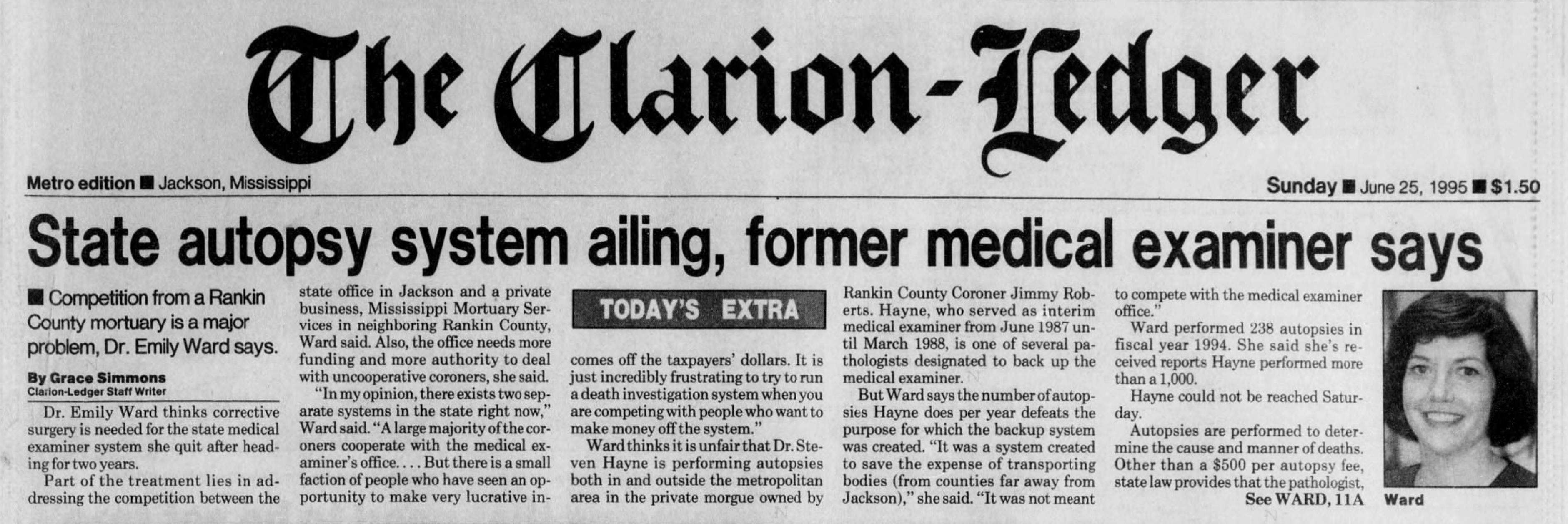
Ward was shocked to learn that Hayne was performing more than 1,000 autopsies per year. She was disturbed by the conditions in which he was doing them and alarmed at how often he was testifying in court. She tried to impose some reasonable limits and professional standards. She would later tell me that she was told “to shut up” if she wanted to keep her job.
Ward’s predecessors had complained that prosecutors who didn’t like their conclusions often went to Hayne for more favorable findings. One former state medical examiner, Lloyd White, told me that one prosecutor actually sent police to the state crime lab to remove a body in the middle of the night without his permission.
Prosecutors are obligated to inform the defense if a state expert gives them exculpatory conclusions. As Ward would learn, that wasn’t happening. When defense attorneys in one murder case learned that Ward had done an initial autopsy before the victim’s body was taken to Hayne, they reached out to her. She had given prosecutors her opinion that the death hadn’t been a homicide. When the state proceeded with criminal charges anyway, she testified for the defense.
For Mississippi prosecutors, this was unforgivable. They saw the state medical examiner as part of the prosecution’s team. In March 1994, two district attorneys filed a formal complaint against Ward with the Mississippi Department of Public Safety. In response, the commissioner of that agency — Ward’s boss — told her she could no longer speak to defense attorneys in a given case without approval from the DA.
Ward pushed back. “When I’m asked to give my opinion about autopsy findings, it is my obligation to make that opinion available to the court once it has been requested by either side,” she wrote in a reply. “If I didn’t . . . I would be contributing to the obstruction of justice.”
Prosecutors responded by cutting Ward out of the loop. They resumed sending their autopsies directly to Hayne, preventing Ward’s office from providing any real oversight. When Ward continued to push for standards and basic protocols, they mounted a campaign to get her fired.
As momentum grew against Ward, other medical examiners around the South came to her defense. McCormick sent a letter to the editor of the Jackson Clarion-Ledger, which was published on November 1, 1994, and signed by the Alabama and Arkansas state medical examiners as well as the medical examiners for Shelby County, Tennessee (Memphis), and Fulton County, Georgia (Atlanta). Medical examiners “are — and should be — willing to meet with” both prosecutors and defense attorneys to discuss their findings,” the letter read. It urged Mississippi officials “to support Dr. Ward’s efforts to make the office what it should be — a neutral, fact-finding agency charged with investigating deaths in the public interest.”
A week after that letter was published, Michael West was elected coroner of Forrest County. The position not only put him in charge of death investigations in Hattiesburg, it gave him the legitimacy of a public office. One of West’s first moves was to circulate a petition among his fellow coroners calling for Ward’s removal. The document depicted her as power-hungry and authoritarian. Just over half of Mississippi’s coroners signed it.
The campaign against Ward was shot through with misogyny. “I thought West was right at the time,” one former sheriff who often used Hayne and West later told me. “Emily Ward struck me as the aggressive, bull-dyke type. She was always sticking her nose where it didn’t belong.” A longtime coroner who supported Ward told me that when he defended her at a professional meeting, West accused him of sleeping with her. West also criticized Ward’s boss, telling the Clarion-Ledger that the public safety commissioner had “never been able to keep that woman under control.”
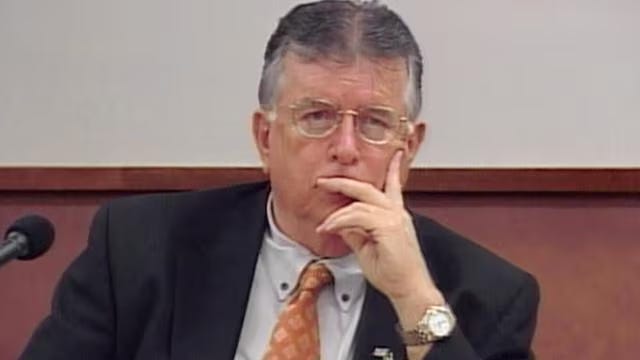
Ward eventually concluded that her position was untenable. In 1995 she resigned as Mississippi state medical examiner. The Clarion-Ledger published a staff editorial that read: “Good ol’ boys 5, professional state medical examiner, 0” — a reference to the total number of people who had held the position and quit in frustration. The office would remain vacant for the next 15 years, effectively giving Hayne free rein.
West was jubilant over Ward’s resignation. She’d “attempted to destroy the death investigation system in Mississippi,” he told the Clarion-Ledger. “[S]he seems to be a very incompetent individual.”
4
By the mid-1990s, West was both the primary ambassador and right-hand man for Hayne’s autopsy business. He also continued to be a relentless self-promoter. His election as Forrest County coroner only elevated his platform. (Note: West has never returned my attempts to interview him over the years. The last time I was able to get him on the phone, he told me to never call him again.)
But a few national media outlets had begun to question his self-made mythology. In a Mississippi murder trial that would come to epitomize the absurdity of West’s career, the “little ol’ dentist from Hattiesburg” testified that the bite marks in a half-eaten bologna sandwich found at the crime scene were “consistent” with the teeth of the accused. An autopsy later revealed a portion of a partially digested bologna sandwich in the stomach of the victim.
But the first case to bring real scrutiny of West from the national press was the conviction of Anthony Keko, a 61-year-old oyster farmer in Plaquemines Parish, Louisiana. In the summer of 1991, Keko and his wife Louise were in the midst of a bitter divorce when Louise was found dead in her bathtub. She had been beaten, shot, and stabbed. Because the couple had been seen arguing in public before the murder, police arrested Keko.
Local officials seemed confident of Keko’s guilt, but there were reasons to be skeptical. The crime scene suggested a violent struggle, yet Keko had no injuries. The police were also unable to find hair, blood, skin, or any other biological material linked to him.
The murder went unsolved for well over a year. But in 1992 a new sheriff took office — one who had campaigned on bringing the perpetrator to justice. He brought in Hayne and West and had Louise’s body exhumed. At that point she’d been buried for 14 months. Nevertheless, West claimed to find a bite mark on Louise’s shoulder that he said could only have come from her husband.
West didn’t take any photos of the alleged bite. He’d later say he was too tired to get out his camera. He and Hayne also failed to properly preserve the skin that showed the alleged bite. So West would testify from memory. Everyone would just have to trust him.
And they did. Keko was convicted and sentenced to life in prison.
Two years later, a state court overturned the conviction. The reason: By the time of Keko’s 1992 trial, a professional forensics organization had suspended West for misconduct — and jurors had not been told about the suspension. A police detective then came forward to say that there had initially been 13 suspects in Louise Keko’s murder, but police focused solely on her husband. West was given only Keko’s dental mold to “match” to the alleged bite mark. In December 1994 the charges against Keko were dropped and he was freed. The murder remains unsolved.
The Keko case gave West the attention he craved. The exoneration — and West’s ever-growing roster of botched cases — garnered stories in Newsweek, the BBC, and ABC News, along with legal publications like the ABA Journal and National Law Journal. West would later put all of this coverage on his CV and boast about it on the witness stand. It didn’t seem to matter that the attention was overwhelmingly negative. All publicity was good publicity.
It also didn’t seem to hurt his reputation with most prosecutors. “I’m quite confident in the guy,” one told the ABA Journal. “I have a lot of faith in him. And I think he makes one heck of a witness.”
But West’s baggage put Jerry Jones, the prosecutor in Duncan’s case, in a quandary. By 1995, judges in three different cases had barred West from testifying, including two in Louisiana. He had been forced to resign from two forensic organizations, and was suspended from another. And at least three men he implicated had since been cleared and released.
Jones decided against using West as an expert witness. So he went looking for a new bitemark analyst.
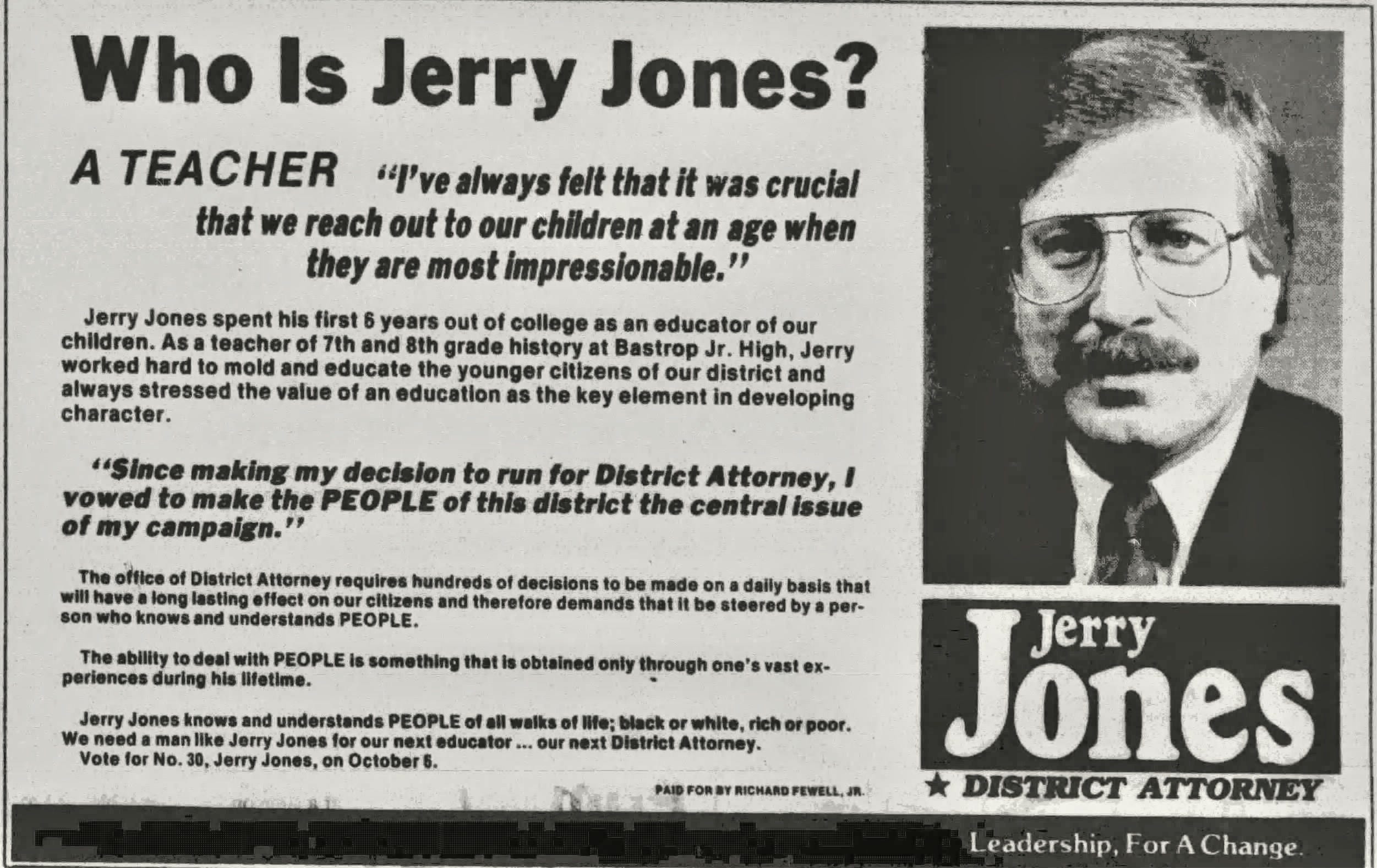
He first reached out to Lowell Levine, a longtime bitemark specialist who had gained national renown after testifying at the 1979 trial of serial killer Ted Bundy. Like many in the field, Levine would later have his own problems — he implicated two men who were later cleared by DNA. But at the time, he was considered a pioneer in forensic odontology.
Levine turned Jones down. The gig would have required him to rely on West’s handiwork — and Levine told Jones that he wanted nothing to do with him. But he did refer Jones to a New York dentist named Neil Riesner. After reviewing West’s photos and Duncan’s dental mold, Riesner agreed to testify.
It was in early 1995 that Duncan’s attorneys learned there was a video of West’s examination of Haley. They asked Jones to send them a copy. He refused. So they filed a motion to compel Jones to turn it over.
Joiner, the presiding judge, reviewed the video in camera — that is, without letting the defense see it. There’s no record of Joiner consulting with any forensic expert about what he saw. Once more, he ruled for the state. Incredibly, he found that the video contained “no exculpatory evidence favorable to the defendant.”
The state pressed forward. Jones would seek to have Duncan executed. Joiner would preside over the trial. And both would do so despite knowing there was a video showing that a major piece of evidence had been manufactured.
5

Shortly after they were appointed to represent Duncan, Focke and Edwards asked Joiner to stop the state from seeking the death penalty. The reason: Neither of them was equipped to defend a capital case.
At the time, most public defenders in Louisiana were private attorneys who had contracts with the state’s indigent defense board. The pay was a pittance, so most made the bulk of their income in private practice. Focke and Edwards argued that, while they were qualified to handle the guilt phase of Duncan’s trial, they didn’t have the time, resources, or training to handle the sentencing phase.
It wasn’t a trivial motion. A capital defense attorney’s main responsibility during a sentencing trial is mitigation — giving the jury reasons to spare the life of the person they’ve just found guilty. It’s a laborious process. It requires hunting down friends, relatives, teachers, and other acquaintances going back to childhood, along with reviewing old school, court, and medical records. It means having clients evaluated for mental illness and intellectual disability.
Today, such work is done by mitigation specialists, who are a vital component of a defense team. But in the 1990s, mitigation was often treated as an afterthought.
Like most attorneys handling death penalty trials at the time, Focke and Edwards weren’t qualified to do mitigation. Nor did they have the capacity to become qualified, at least on paper, in time for Duncan’s trial. As they argued to the judge, the training and extensive preparation would require them to divert time and resources away from their other cases. Ethically, they couldn’t give Duncan a proper defense while also effectively representing their paying clients.
This was a common problem at the time, particularly in Louisiana. In the 1990s, it was one of the most aggressively pro-death penalty states in the country. It was also among the worst at providing adequate indigent defense. Because of the low pay and huge time commitment, attorneys who took capital cases tended to be fresh out of law school or lawyers with dubious track records. Judges were known to assign death penalty cases to real estate lawyers, oil and gas lawyers, or divorce attorneys, often with little time to prepare.
Meanwhile, there was little accountability for bad lawyering. On multiple occasions the Louisiana Supreme Court and state bar found that, while defense attorneys may have failed their clients in capital cases — including neglecting basic tasks like interviewing eyewitnesses — it would be unfair to discipline them since the state didn’t require death penalty attorneys to meet even the most basic standards.
For Edwards and Focke to attest that they couldn’t effectively represent Duncan should have been enough to remove them. Joiner waited seven months, then denied the motion.
It would take four more years for Duncan to go to trial. By the time jury selection started in March 1998, both Edwards and Focke had left the case. Focke left the state to practice in Texas. Edwards took himself off the case just three weeks before a set trial date after taking a job with the federal public defender’s office in New Mexico.
For all of this time, Duncan was held in the Ouachita Parish jail, on the top floor of the courthouse. The design was based on the theory that putting prisoners on the top floor would make it harder for them to escape. But it also created a potentially catastrophic fire hazard.
The jail was a humanitarian disaster in other ways, too. Defendants accused of serious crimes were housed in cells with up to 10 men. Those facing less serious charges were placed in a large, dormitory-style cell that could hold as many as 90 people. There was no air conditioning. Rapes and assaults were common. From the early to mid-1990s a federal judge repeatedly found that the conditions were unacceptable, and threatened to close it down.
As a man accused of sexually assaulting and killing a child, Duncan had a target on his back from day one. “This was also at the height of the AIDS epidemic,” says Judith Eichenbaum, who worked on Duncan’s defense team in the late 2000s. “Chris was accused of raping a child. You can imagine what he feared.”
Duncan’s mental state deteriorated. He became obsessed with Biblical numerology and apocalyptic religious themes. He began hallucinating and disassociating from his lawyers and the reality of his pending trial. According to court records, a psychiatrist would later testify that Duncan spent 12 to 16 hours per day “working on a complex formula he has deduced from various sources, including the Bible and the Pyramids of Ancient Egypt.”
When I asked Duncan about his experience in jail, he seemed reluctant to revisit that time. But according to Eichenbaum and case records, it was a hellish place to be. “He saw drug addicts suffer, overdose, and die right in front of him,” Eichenbaum says. “He tried to talk one fellow prisoner out of hanging himself in the middle of the night. He wasn’t successful. He sat in the dark and listened to the sounds of that man killing himself.”
When I asked Duncan about that incident, he replied with a curt correction. “That happened twice,” he said.
6
After his original attorneys left, Duncan’s case was assigned to a new pair of lawyers: Lee Perkins and Louis Scott. Neither had handled a death penalty trial and both had to take a class to be eligible to represent him.
Perkins had previously worked for Jones as a prosecutor. Scott, a civil rights attorney and activist, would eventually become known for losing capital cases. “We called him the Angel of Death,” one defense attorney told me. In fairness, this was in part because he took cases no one else would. The same attorney told me, “Louis was a good and honorable man who did the best he could.”
I’ve interviewed Scott several times over the years. But he did not respond to my request for comment and several people have told me that he has been in poor health since having a stroke in 2020. Perkins passed away in 2024.
Duncan’s lawyers made several poor decisions in their handling of his case. Some were due to being overworked and under-resourced. For others, all their options were bad.
Their first major error was their failure to watch the West video.
It’s not entirely clear when Scott and Perkins got ahold of the video. Duncan’s original trial attorneys had tried to get a copy but were denied by the judge. Case records show that the new lawyers eventually received the video from the state. But then they failed to use it.
That was a costly misjudgment. The state’s expert witness, Riesner, would testify based on the photos West took after his exam. So what West did during that exam was critical. Not watching the video was a pretty fundamental abdication of the duty to provide a thorough defense.
At the same time, lawyers dealing with bitemark evidence were often in a no-win position in the 1990s. This was the heyday of forensic odontology. Defense attorneys generally chose one of two options: they could either attack the field broadly as unscientific and illegitimate, or they could bring in their own bitemark analyst to counter the state’s witness.
“In a particularly dark moment during his closing argument, Jones compared what Duncan did to Haley to the way a hunter bleeds out a deer.”
In an ideal world, defense attorneys would have attacked the field — because it isn’t legitimate. There is no scientific foundation for the idea that bite marks on human skin can be matched to one person to the exclusion of everyone else. First, there’s no evidence that each of us has unique dentition. But even if that were true, there’s no evidence that human skin is capable of recording and preserving bite marks in a way that captures that uniqueness.
Decades of research has shown that forensic odontology lacks scientific validity. When given blind proficiency tests, analysts couldn’t agree on whether the test marks came from human teeth — or were even bites at all. Every scientific body to evaluate bitemark analysis has determined that it isn’t reliable enough to be used in court. Yet, with just a few recent exceptions, every court to consider the validity of bitemark analysis has upheld it.
Once courts started accepting bitemark evidence as legitimate, most defense attorneys decided that it was a waste of time and resources to challenge the field as a whole. So they went for option two: calling their own bitemark analysts to counter state experts. That had two unfortunate effects: it further legitimized the field in the eyes of the courts, and it made it far more difficult for people wrongly convicted with bitemark evidence to challenge their convictions later.
By the mid-1990s, it wasn’t difficult to find experts willing to contradict West on the stand. He had been discredited even within the field of bitemark analysis. Many analysts saw him as a stain on their field, and were eager to distance themselves from him.
But in Duncan’s case, West wouldn’t be testifying. Riesner would. And Riesner had come at the recommendation of Levine, who, along with Richard Souviron, had become something of a forensics star after the Ted Bundy trial. (Souviron, too, would later give testimony that contributed to wrongful convictions.)
Scott and Perkins decided not to challenge bitemark evidence as a whole, and to simply counter Riesner with their own expert. They retained Souviron.
Souviron reviewed the hospital Polaroids and the photos taken by Hayne and West. He concluded that the marks on Haley weren’t bites at all.
It’s instructive that two experts could look at the same marks on the same body and reach such different conclusions. Testifying at Duncan’s trial, Riesner contradicted West on one of the alleged bite marks, saying it wasn’t a bite at all. But Riesner also claimed to spot an additional bite in one of the photos, which West had overlooked. He also said there were no fingernail scratches on Haley, contradicting one of Hayne’s justifications for determining that she had been forcibly drowned. It was a matryoshka set of forensic quackery.
The entire time, of course, the prosecution, defense, and even the judge all possessed a video showing that West had manufactured the bite marks, corrupting the evidence so thoroughly, it should have rendered any other injuries found on her body all but useless.
7
One of the most bizarre moments from Duncan’s trial came when prosecutors claimed to have caught him in a lie. Duncan said he fed Haley oatmeal for breakfast on the morning she died. But his neighbor, Floyd Bennett, said that when he attempted to clear Haley’s airways to perform CPR, he had to remove oatmeal from her mouth. He described it as “dry.”
Prosecutors made a big deal out of this. Jones claimed in his closing argument that this was slam-dunk evidence that Duncan had tried to cover up his crime. He repeatedly told the jury that Duncan quickly stuffed dry oatmeal into Haley’s mouth before taking her to the neighbors’ house.
Did you hear Floyd Bennett? That oil field worker. Fine man. Did his best to save that dead baby. Floyd removed something from the child’s mouth that everyone on earth should find interesting. Dry, did you get that? Did y’all catch that? Dry, uncooked oatmeal. An absolute physical impossibility for a baby to lay face down in a bath tub and have dry, uncooked oatmeal in her mouth. At a minimum it had to be wet.
This focus on the oatmeal never made much sense to me. It’s not unusual for instant oatmeal to include dry clumps if it’s not thoroughly stirred. It seems possible for Haley to have swallowed some, then vomited it up as she drowned.
But more to the point, it’s not at all clear how this was proof that Duncan tried to cover up his crime. It would be baffling to think how stuffing dry oatmeal in her mouth would somehow absolve him of raping and murdering her.
Perhaps even stranger was a related finding by Hayne, which Jones presented as proof that Duncan had lied. Hayne testified that he found no oatmeal in Haley’s stomach — only pickle, tomato, and raw onion.
Kathy Kelly, who would later represent Duncan, told me that she suspected Hayne may have mixed up the contents of Haley’s stomach with those of someone else he had autopsied that day. That’s certainly possible. Hayne had a history of such incompetence. He once described in detail the spleen of a man whose spleen had been removed years earlier.
Given what we now know about Hayne, it’s also possible that he simply lied.
“Do you know of any two-year-olds who eat raw onion?” Allison Statham asked me last year. “I don’t. We wouldn’t have had raw onions in the house. And there’s no way my mom would have fed her raw onion the night before. Haley would have spit it out.”
Hayne said other things during his testimony that were either untrue or deliberately misleading. He claimed, for example, that one bruise on the back of Haley’s head had been inflicted shortly before her death, and was consistent with a thumb forcibly pushing her down. But that bruise had been documented by doctors after her trip to the emergency room a few weeks earlier, when a dresser had fallen on top of her.
Hayne’s conclusion that Haley had been “forcibly drowned” was also problematic. There’s no reliable way to distinguish an accidental drowning from an intentional one. Hayne based his conclusion on the aforementioned bruise on Haley’s head, along with scratches on her jaw and neck that aren’t apparent even in his own photos. He also mentioned her torn frenulum, but that’s a common injury when ER staff are trying to quickly intubate someone.
Hayne also claimed Haley’s “brain showed no evidence of seizure activity.” This was misleading at best. While a physical examination of the brain might reveal conditions that could cause seizures — a tumor, for example — it isn’t a reliable way to determine if the deceased recently had one.
8

The other big mistake Duncan’s attorneys made at trial was to concede that Haley had been sexually assaulted.
To be fair, the injuries to Haley’s anus were alarming. The photos Hayne took were especially gruesome. Pediatrician Edward Gustavson, who testified for the state, said it was the most traumatic such injury he had ever seen.
When I first saw the photos, I wasn’t really prepared for what they showed. I, too, thought it was clear that someone had assaulted Haley. The only question seemed to be whether or not it was Duncan.
At trial, Hayne suggested that the injuries were most likely caused by “an adult male penis.” Gustavson testified that it could only have been caused by a penis. Both were assertions that other medical experts have since said aren’t something a doctor could know. Even pathologist Robert Kirschner, Duncan’s own expert witness, agreed that Haley had been assaulted, though he refused to speculate on what specifically had caused her injuries. He also disputed Hayne’s claim that the anal injuries could only have been inflicted just before Haley’s death, estimating that it could have been up to 24 hours earlier. But Duncan was the last adult alone with Haley, so this was still damning for his defense.
At trial, the defense offered two theories to explain the injuries. Both strained credulity. First, they noted that a known sex offender lived in the neighborhood. They suggested that the offender may have snuck in while Duncan was taking a shower, assaulted Haley, and left without Duncan noticing. That seems improbable. But also, both Duncan and Statham told police that Duncan had showered immediately upon waking up, not after Statham left for work.
Second, they suggested that Haley’s mother or grandparents may have abused her. In his closing argument, Louis Scott actually compared Haley to a car that a group of people shared and abused, “and the car gave out on the person it was loaned to.”
Duncan’s attorneys had no evidence for either theory. One local reporter wrote that jurors “rolled their eyes” when Scott repeatedly suggested that someone other than his client may have sexually assaulted the child with one of her mother’s shoes.
Once the defense conceded that Haley had been abused, the jury was left with a horrific and uncontested narrative. Haley had been brutally sexually assaulted shortly before she died. And Duncan was the last person known to have been alone with her.
But the evidence that those injuries were the product of a sexual assault was always thin. At trial, every expert for both sides agreed that Haley would have bled profusely if she had been anally raped. Jones repeatedly invoked scenes of blood-soaked gore to drive home the point.
Yet no one saw any evidence of bleeding — not the neighbors, not the paramedics, not the ER doctors, and not even Hayne, whose photographs and autopsy report showed no signs of blood or clotting.
To explain away the lack of blood, Jones claimed that Duncan had let Haley “bleed out” in the bath, then furiously scrubbed her body clean. In a particularly dark moment during his closing argument, Jones compared what Duncan did to Haley to the way a hunter bleeds out a deer.
You guys that hunt know what happened. You hang them out to bleed out in the back bathroom... It takes time. Blood clotting, bleeding, it takes time. He left her in the back bathroom. Blood red water. ... Let her bleed out and washed her. Folks, and he washed her and he washed her and he washed her…He had to wait. He had to wait. Had to clean it up.
The problem with this grisly narrative is that there’s zero evidence to support it. The police found no blood in the apartment. There was no blood on Duncan’s clothes. The police also searched the apartment and surrounding area and found no bloody towels or rags, or any used cleaning supplies. There’s no evidence that Duncan drove anywhere to dispose of any of those items. There was just no sign of any blood at all, much less the amount of blood there should have been if the state’s account had been accurate.
Another problem was that Duncan wouldn’t have had time to do all of those things. Recall that Duncan initially neglected to tell police that he went to the convenience store while Haley was in his care. At the time, that seemed bad for him, because it revealed that he’d left the child alone. But it would also put a hole in the state’s narrative — one they’d have to fill.
Duncan’s neighbor, Bennett, who performed CPR on Haley, was outside his home playing basketball with his son on the morning Haley died. In his initial interview with investigators, Bennett said he saw Statham leave for work around 8:45 am. He then said he saw Duncan walk to the convenience store around 8:50 or 9:00 am. They even exchanged pleasantries. According to Bennett, Duncan rushed over to the house carrying Haley’s body about a half hour later. The paramedics then arrived with Haley at the hospital at 10:51 am.
“No one saw any evidence of bleeding — not the neighbors, not the paramedics, not the ER doctors, and not even Hayne.”
This timeline posed a problem for prosecutors. It meant that between 9:10 or 9:15 am — when Duncan would have returned from the convenience store — and around 10:30 am — when Duncan arrived at the neighbors’ with Haley — Duncan raped Haley, drowned her, let her bleed out, cleaned up all the blood, disposed of any cleaning materials, then wrapped Haley up in a towel and took her next door while feigning grief. It just wasn’t plausible.
So by the time of Duncan’s trial, prosecutors had a new timeline and a different sequence of events. Bennett now said he saw Duncan go to the convenience store later — between 9:30 and 9:45. He also no longer claimed to have seen Statham leave for work. This allowed Jones to push his timeframe back. He now estimated that Statham left for work at 8:30 am, widening the window for the state’s theory of the murder. Under the new narrative, Duncan waited until Statham left, raped Haley, drowned her, changed his clothes, then nonchalantly walked to the convenience store while she bled out — calmly exchanging pleasantries with Bennett along the way. He then returned to clean up the blood, dispose of the cleaning supplies, and take Haley over to Bennett’s.
To support the new timeline, Jones elicited more unscientific testimony from Hayne and Gustavson. According to Bennett, when Duncan brought Haley’s body over, her skin was cold to the touch. Based on this remark, the state’s two experts concluded that the girl must have been dead for at least an hour.
Here’s how Jones framed this in his closing argument:
“Time nails him. Time got him. Time convicts him. Why? Mama left at 8:30. 10:30 baby’s taken next door. Revive the baby. There’s a problem. Baby had been dead an hour and a half. She was killed at 9:00.
Determining time of death is an inexact science. As multiple medical experts have since stated in affidavits for Duncan’s defense, it just isn’t possible to estimate time of death with that sort of precision based on a layperson’s vague description. In this case, a toddler had just been pulled soaking wet from a bath and rushed outside in a towel — in the middle of December. (Hayne also claimed that Haley’s blood-oxygen levels supported an earlier time of death, but there’s no scientific basis for that, either.)
Jones also told the jury that Duncan’s own pathologist, Kirschner, agreed with the state experts that Haley had died at 9 am. But Kirschner never said this. He said nearly the opposite. He told the jury that because the paramedics and ER doctors hadn’t noticed “advanced changes in terms of death including onset of rigor mortis,” Haley couldn’t have died any earlier than 9:30 am.
There was also some far more reliable medical evidence that refuted Jones’s narrative. If Haley had really died when Jones claimed — and lost all her blood — her body would have lost a lot of heat. ER staff took her core temperature after she arrived — well after Bennett had found her “cold to the touch.” It was a normal 98.6 degrees. Perhaps most critically, Haley was also given a hemoglobin and hematocrit test, which literally measures the volume of blood in the body. The results were normal.
9
There has never been a particularly satisfying explanation for Haley’s anal injuries. Their alarming appearance remains the most pressing unanswered question from Duncan’s case. When District Attorney Robert Tew defended his conviction before the Louisiana Supreme Court earlier this year, he emphasized this point. Even if the judges disregarded the bitemark testimony, he said, they would still be left with those jarring and unexplained injuries.
In his most recent court filings, experts for Duncan’s defense say the injuries could have been caused by straining during defecation (Haley was constipated when she died) or by severe diaper rash. They also point out that the anus often dilates after death, and that this can look particularly alarming, especially in children. At the time of Haley’s death, dilation was commonly mistaken for signs of sexual abuse (Hayne repeated this mistake in at least one other death penalty case).
But there’s another explanation deep in the paperwork of this case that is a better fit for Haley’s symptoms. In the medical records after her second seizure, an ER doctor diagnosed her with a condition called Stevens-Johnson syndrome.
Attorney Kathy Kelly mentioned this condition when I started looking into Duncan’s case back in 2008. At the time, her office was still investigating the possibility. When I began revisiting the case a few years ago, I found the reference in my notes and looked up Stevens-Johnson syndrome. The resulting images were disturbing — and strikingly similar to the photos from Haley’s autopsy.
Stevens-Johnson is a severe, sometimes fatal skin disorder. It begins with a rash, then quickly gets more painful as it blisters. Eventually, the top layer of skin dies and sloughs off. It tends to affect mucous membranes like the eyes, mouth, and anus.
Researchers still aren’t certain what causes the condition, but it’s commonly associated with allergic reactions to certain classes of drugs. Two of those classes are anti-seizure medications and sulfonamide antibiotics. Haley was on both. It’s impossible to say how much of either was in her system at the time of her death because, again, her blood sample was destroyed before it could be tested.
Haley had stayed with her grandparents for about a week before her death. Her grandmother said in a police interview that, during that visit, Haley complained about her bottom being sore. Her grandmother told investigators that she’d noticed “soreness” “around the opening” of her anus, and added that it “definitely was not diaper rash.” She also said that, on a previous occasion, Haley had gotten “a strep infection on her little bottom” and then had an allergic reaction to the antibiotics they gave her to treat it.
I asked two medical examiners who are unfamiliar with Haley’s case about Stevens-Johnson syndrome. Both said that even an experienced doctor could easily mistake the symptoms for sexual abuse. The blistering rash can be gnarly. But importantly, because it’s a skin condition, it would not cause extensive bleeding the way a sexual assault would. It also wouldn’t cause internal tearing or injury.
This is all consistent with the photos from Haley’s autopsy. Forensic pathologist Tom Bux, an expert for Duncan’s defense, wrote in an affidavit that Haley’s injuries showed “even radial lines surrounding the circumference of the anus,” the sort of injury associated with an infection. He added that forced penetration would produce deep, uneven lacerations, which aren’t apparent in the photos. In another affidavit, medical examiner Judy Melinek also wrote that the autopsy photos showed indications of an infection, not an assault.
The only way to get a definitive answer would be to microscopically examine the tissue slides that should have been prepared after Haley’s autopsy. Hayne claimed to have prepared such slides. This, he said, was how he’d concluded that Haley was most likely penetrated by “an adult male penis.” But when Duncan’s defense team asked for copies of the slides, Hayne failed to produce them, just as he’d done in other cases.
A Louisiana court ordered Hayne to produce the slides in 2008. But he said he no longer had them. He first said he’d sent them to the state crime lab in Mississippi. When that lab said it had never received them, Hayne claimed to have sent them to the state lab in Louisiana, and then to the office of George McCormick. Both also said they never received the slides.
Even if the slides were lost, Hayne should still have preserved the tissue in wax blocks that would allow other analysts to recreate them. And barring that, he should at least have had his contemporaneous notes. He claimed to have lost all of those, too.
In 2009, Duncan’s attorneys subpoenaed Hayne to appear at an evidentiary hearing so they could ask him about the slides. He didn’t show up. He’d later claim that, as a resident of Mississippi, Louisiana had no jurisdiction to compel him to testify. This was not true. In agreeing to perform the autopsy on Haley back in 1993, Hayne had made himself available to Louisiana courts.
As Duncan’s attorneys have recently argued, it seems pretty clear that Hayne never created the slides. He lied about making them, and he lied when he said they were the basis for his claim that Haley had been abused.
This was always the most logical conclusion. Creating tissue slides is a laborious, time-consuming process that can sometimes take days to complete. According to his own records, Hayne spent, at most, two hours on Haley’s autopsy.
10
In 2003, a Mississippi man named Devin Bennett was convicted and sentenced to die for the death of his two-year-old son Brandon. Steven Hayne was the state’s expert witness. He claimed to have found the telltale symptoms of Shaken Baby Syndrome, a diagnosis that has since been widely discredited — though some courts have yet to catch up.
When looking for a witness to review Hayne’s work, Bennett’s attorneys saw a familiar name on the state’s list of certified forensic pathologists: former Mississippi state medical examiner Emily Ward.
Ward was working in Alabama at the time, and had little interest in revisiting her tumultuous tenure in Mississippi. So she declined. But because she was still on the state’s list, Bennett’s attorneys eventually got a court order compelling her to look at Hayne’s work. She reluctantly agreed, and was appalled by what she found. “I think it was a miscarriage of justice,” she told me in a 2008 interview. “I still think Devin is innocent.”
At Bennett’s trial, prosecutors tried to discredit Ward by portraying her testimony as a vindictive attempt to get back at Hayne for forcing her resignation. They even introduced Michael West’s 1995 coroners’ petition into evidence. The trial judge, a former prosecutor who had used Hayne himself, overruled objections from Bennett’s attorneys. Bennett was convicted and sentenced to death. He is still on Mississippi’s death row.
“That case was like a lot of others,” Ward told me. “A baby died, and so someone had to pay for it.”
That’s something you often hear from defense attorneys in Mississippi and Louisiana. There are prosecutors who simply don’t believe that babies die on their own. There are no pure accidents or cruel illnesses that strike down innocents. Some mortal being must have had a role. This is especially true when the parents or caretakers happen to be poor.
“There’s this idea that God doesn’t let innocent babies die for no reason,” a public defender in Jackson told me last year. “Somebody has to be punished.”
Hayne and West were often the tool prosecutors used to inflict that punishment. There are countless cases like Duncan’s, where the question should not have been who killed the child, but whether the child was killed at all.
These wrongful convictions for deaths that were actually caused by an accident or illness are especially hard to overturn. There’s no DNA to point to the real perpetrator. Even if a prisoner can show that an expert’s testimony was clearly wrong or unsupported by science, the courts typically demand that the testimony be a critical component of the state’s case — that without it, the jury wouldn’t have convicted.
Hayne’s myriad mistakes and misleading statements at Duncan’s trial should have been cause to throw out his testimony entirely. More broadly, his preposterous testimony in other cases should have been cause to question his credibility and revisit every case where he took the stand.
But this isn’t how appeals courts work. With rare exceptions, they consider each case in isolation, weighing only whether the expert testimony was credible in that particular case. And though courts are supposed to consider the cumulative effect of such errors, that’s a difficult argument to win.
Short of DNA, a prisoner generally needs previously undiscovered, blockbuster, slam-dunk evidence showing that the state lied, withheld critical evidence, or manufactured evidence.
Chris Duncan had all of that and more in 2009. It would still take another 16 years to get him out.
Unbelievable that every case Hayne testified in hasn't been tossed.