
A warning from a friend
A Russian dissident says the U.S. is headed down a dangerous and familiar road

A couple weeks ago I attended the conference “Liberalism for the 21st Century,” hosted by the Institute for the Study of Modern Authoritarianism (ISMA). The conference featured speakers and panels discussing the growing threat of authoritarianism, both in the U.S. and around the world.
ISMA was founded by my friend and former colleague Shikha Dahlmia, who readers of this site may know better as the publisher of the Unpopulist newsletter. I still remember phone conversations with Shikha when ISMA was just an idea she was batting around in her head. In just a few years, she has built an impressive and needed bulwark against the threat we’re facing.
There was some comfort in the camaraderie of smart people from across the political spectrum united by a shared understanding of what we’re up against. At the same time, there was also a sense of foreboding about what’s coming — that so many smart, otherwise sober-minded people felt that a conference like this is necessary in the first place.
There was also no avoiding the looming reality outside — and it was quite literally outside. We convened at the Watergate Hotel in Georgetown, on the same day Trump began deploying National Guard troops in Washington, D.C.
More than a few people I spoke to made reference to my book on police militarization, and quipped that I must feel conflicted about being right, but also being right about something so awful. This probably gives me too much credit. I’ve been warning for years that our police departments are growing increasingly militarized. I haven’t been warning — or at least I hadn’t until around 2017 — that we may one day elect a president who will simply unleash the military on major U.S. cities just to project his power.
It isn’t that I never thought this was possible. It’s more that it seemed too farfetched a scenario to worry about. To me, it seemed like the sort of thing that at worst might happen after a crisis, such as another September 11-style attack. But until Trump’s first term, I had never thought it likely that we’d effectively end a centuries-old, founding-era principle of a free society because of one man’s spite and ego. More to the point, to the extent that I did worry a military police state, that sort of scenario was really beyond my purview. I write about policing. If we ever got to the point in which a president was sending the military into cities for purely political reasons, aggressive policing wouldn’t be our most urgent problem. Our most urgent problem would be authoritarianism.
And so here we are.
Outside, the Watergate is an ugly, sprawling behemoth of a hotel. It looks like series of awkwardly parked cruise ships. Inside it’s spectacular, bedecked in a 1970s-meets-art deco aesthetic that somehow still feels modern. But the venue’s storied history was also a reminder of how bad things have gotten. The Watergate scandal was also an assault on American democracy, but it’s downright quaint compared to what’s happening now. Nixon and band of mustachioed henchmen were corrupt, racist, cynical, and criminal, but those abuses also took place during an era in which the public could still be shocked by abuse of power, when Congress was still capable of shame, remorse, and of asserting its oversight authority, and when Republican Party leaders still capable of recognizing — if a bit late — that they’d backed a dangerous demagogue. The Howard Baker-esque consciences on the right have all left or been chased out of the Republican Party. It’s all cowards and sycophants, now.
The current administration perpetrates a Watergate-level scandal each week, usually several times per week. They’re doing it shamelessly, boastfully, and right out in the open. They can do it because know there’s almost no chance they’ll ever be held accountable. Most of the media no longer reports these crimes as scandals, and certainly not with the urgency they demand. They’re presented now as one side of an ongoing political debate. So we’re getting numb to them.
At one point during the conference I chatted with a friend and former colleague I’ve known for 25 years. (I’m not using his name because it was a casual conversation.) He might be the most well-read person I know. He’s a scholar who has studied authoritarianism for decades, but he’s also an activist who has provided aid and support for dissident movements fighting authoritarian governments dating back to the Cold War — at times at some risk to himself. Because of that work, he’s seen the abuses of authoritarian states firsthand. So he’s been scornful over the years when Americans have hyperbolically likened their political opponents to Hitler, Stalin, Mao, Pinochet, or some other totalitarian figure. I suspect that once you’ve seen real authoritarianism on the ground, that sort of posturing probably seems insulting.
In other words, I’ve always found him to be a sober realist about these things. So at the conference I asked him straight up, on a scale of one to ten, how worried he is about what’s happening in the U.S. right now. I was hoping he’d give me a historical reality check — that he’d tell me my own fears are exaggerated.
He answered, “I think I’m at eleven.”
I spoke with another old friend and colleague who works in AI and data systems. I asked her if DOGE’s access to health records, financial records, and other sensitive data is as bad as it seems. “However bad you think it is, it’s worse,” she answered. “They have everything.”
If there was widespread agreement at the conference about the urgent state of things, there was plenty of disagreement on how we got here, and how we get out. I found it frustrating, for example, to hear institutionalists continue to defend the Supreme Court. I’m not sure how you can simultaneously argue that the court is still relevant and important but also blameless for failing to stop the worst excesses of this administration. I’m not sure how you can claim the court is bound by the law, is limited by norms and procedure, and lacks the power to enforce its rulings, and therefore we shouldn’t blame it for failing to confront the administration, but also that we should continue to treat with the reverence and respect it deserves. That doesn’t sound to me like a coequal branch of government. It sounds a branch that’s useless at best, and coopted at worst. That’s especially true given that lower-ranking federal judges are standing up to this administration — and the court isn’t backing them up.
One of the more frustrating themes that repeatedly came up at the conference is blaming “woke-ism” and the left for the rise of MAGA. One panelist pointed out that after the Texarkana region received a bounty of funding for renewable energy projects from the Biden administration, the region then voted for Trump in 2024 at a higher rate than in the previous two elections. This panelist attributed this to the Democrats’ embrace of culture war issues. I found his position puzzling, mostly because because Kamala Harris and the Democrats never embraced culture war issues. Harris ran as a moderate, tough-on-crime prosecutor.
These themes also came up in my conversations with a few attendees. We’re currently looking down the barrel of fascism, the argument went, because we defunded the police, because Democrats use “woke” language, and because Kamala Harris openly embraced trans rights and undocumented immigrants.
The problem is that none of these things actually happened, either. No police departments were defunded. Harris ran away from immigration, as a border hawk. And there’s no universe in which trans rights were at the forefront of Democratic messaging in 2024.
Oddly, two separate people told me they were still angry at Harris for running a campaign ad touting her support for government funded sex reassignment surgery for undocumented immigrants. They’re right about one thing: the headlines for that story were basically a Mad Lib of right-wing grievance.
But the Harris campaign never ran any such ad. Trump did, using footage from an interview Harris gave not in 2024 but in 2019. The policy she endorsed in that interview happened to be federal law at the time, and one with which the Trump administration was complying. It’s also a complete non-issue. Just two federal prisoners have sued to obtain gender-affirming surgery. And fact check groups have yet to find a single instance of an undocumented immigrant getting such surgery.
These conversations were especially frustrating because they showed that even people who had come to a conference about how Trump and his movement have duped the country . . . could still be duped by Trump and his movement.
There are lots of plausible reasons why Trump’s share of the 2024 vote increased in just about every part of the country. I think there’s persuasive evidence that the general anti-incumbent sentiment sweeping the globe last year was probably the dominant factor. But to the extent it was the culture war, it certainly wasn’t Harris’s touting of those issues, because she didn’t tout them. She barely mentioned them at all.
What Harris did do is run for president as a black woman. She didn’t even really emphasize that part of her identity — recall that when Trump started lobbing racist, sexist attacks at her, she didn’t really take the bait. She did highlight the impressive achievement of her immigrant parents, and her mother in particular. But white politicians have touted that sort of immigrant success story for most of our political history.
It seems clear now that a black woman merely not apologizing for who she is made much of the country see her as a divisive culture warrior, even as she ran as on a fairly conventional Democratic Party platform. So when people who pride themselves on their centrism cite the 2024 vote tallies in places like Texarkana as an example of how wokeism is enabling fascism, it isn’t clear to me what exactly they’re suggesting. Should we be more tolerant of people who see a black woman president as a threat to their culture and way of life? Should the Democrats only nominate white men to be president? Should we be more tolerant of bigotry in general? More tolerant of people who spread vile lies about immigrants and yearn to make them suffer? More tolerant of people who support erasing minority achievements from history? More tolerant of police brutality?
That all seems more like capitulating to the threat than fighting it. You preserve liberal democracy by robustly fighting for its animating principles, and by explaining why they’re worth preserving. Compromising those principles in the hopes of winning over more people put little value in them seems . . . unproductive.
Republicans are going to paint Democrats as far-left extremists no matter what positions they take. If that’s the case, you might as well defend the positions you believe to be principled, moral, and correct by actually explaining why those positions are principled, moral, and correct. You might as well go ahead and lead.
The most moving and inspiring speaker of the conference was Vladimir Kara-Murza, a Russian journalist turned activist and political dissident whom Putin has imprisoned and twice tried to assassinate.
In chilling detail, Kara-Murza narrated Putin’s rise and rapid consolidation of power. Putin was first elected in 2000 with just a hair over a majority of the popular vote. He immediately began dismantling Russian institutions. He manufactured faux crises to demagogue minority groups (in his case, Muslims and LGTBQ people). He directed his crony oligarchs to take over and dismantle media outlets that had criticized him. And he quickly started targeting his political opponents with manufactured criminal charges.
The parallels are hard to miss. Putin was able to dismantle those institutions and consolidate his power in less than a year. By 2004 he claimed to have won reelection with an improbable 72 percent of the popular vote.
The main difference between Putin and Trump is that Putin is much smarter, more savvy, and and less reckless. Kara-Murza explained how Putin has been able to appeal to the vanities of U.S. presidents to manipulate them. I’m still struck by the story he told about George W. Bush, in particulr. Putin knew that Bush looked to his faith to guide his decision making. So the first time they met, Putin told Bush a story about how, when he was a KGB agent, a fire had destroyed everything he owned. The only thing that survived was, miraculously, a gold cross that his mother had given him. So he wore the cross every day. As Kara-Murza pointed out, the story was transparently farcical. The Soviet Union was an aggressively atheistic regime. No KGB agent would have risked the consequences of being caught wearing a cross.
But the story worked. At a press conference to close the summit, Bush declared of Putin, "I looked the man in the eye. I found him very straightforward and trustworthy – I was able to get a sense of his soul."
Russia was a young and troubled democracy in 2000, so its institutions were fragile. Ours are older and more resilient. But they aren’t infallible, and Trump’s reelection after four years out of office have allowed him to surround himself with people who learned from the failures of his first administration. Trump’s full-frontal assault on the courts, media, universities, and private industry — and the capitulation we’ve seen in response — have put us on a dangerously similar path.
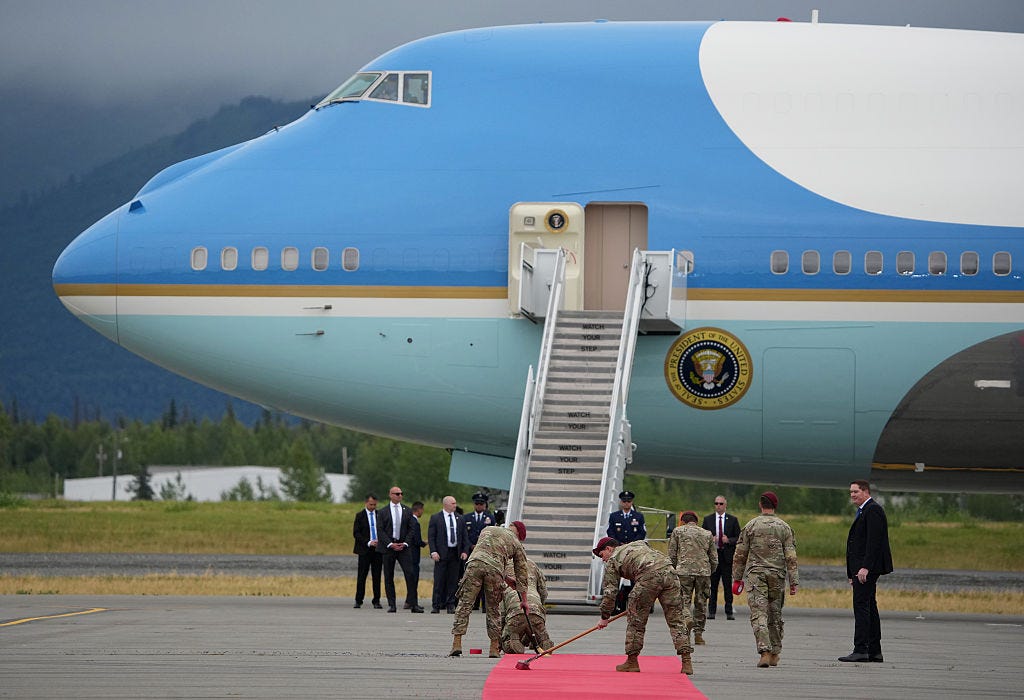
The day after Kara-Murza’s speech, Trump met with Putin in Anchorage. In a stunning display of fealty, Trump had U.S. military personnel literally roll out a red carpet for the dictator. Trump then waited giddily for Putin to arrive, clapping his hands in eager anticipation like an aspiring schoolyard bully who had finally persuaded the established bully to come over for a playdate.
Putin is of course a war criminal. Alaska carries imperialist symbolism for Russia, but they met in Anchorage mainly so Putin could avoid flying over countries where, should his plane be grounded, he could have been arrested under international law. Putin has deliberately targeted civilians in Ukraine, and there’s a large and growing pile of evidence that Russian soldiers have tortured, massacred, and weaponized sexual violence against Ukrainians. Putin has also removed an estimated 60,000 Ukrainian children from their parents and placed them with Russian families. That would make him the planet’s most prolific trafficker of children.
Obviously it is sometimes necessary to negotiate with evil regimes. But it isn’t necessary to fete them. It isn’t necessary to shower them with praise after publicly humiliating the leader of the country they’re currently ravaging.
The reason Trump praises and celebrates Putin because he wants what Putin has. Putin isn’t just an autocrat, he’s an autocrat who plundered his country to make himself one of the richest men alive. About 10 years ago, a libertarian group invited me to give a speech in Moscow. One member of the group told me that the few remaining independent journalists and dissidents in the country at the time had an ongoing game — they tried to identify people Putin had known personally for more than 25 years who wasn’t either a billionaire, dead, or incarcerated. The list grew shorter by the day. The group that invited me to speak doesn’t exist anymore.
Within days of meeting with Putin, Trump vowed to end mail-in voting in U.S. elections, apparently on the advice of Putin. Trump said the Russian president told him he would have defeated Joe Biden in 2020 were it not for mail-in votes. Trump didn’t explain how Putin would know this, or why anyone should care what a foreign despot thinks about how the U.S. should run its elections.
I was in the midst of writing this post when news broke about the Kash Patel-led FBI’s raid on John Bolton. I personally think John Bolton orchestrated and pushed some monstrous policies. But Patel isn’t targeting Bolton for any of that. He’s targeting Bolton because Bolton has criticized the president (and, apparently, because Bolton refused to hire Patel for a job — really).
The administration is claiming the raid on Bolton’s home was related to misuse of classified documents. There has been some reporting that the administration thinks Bolton was leaking damaging information about Trump to the media. I guess we’ll see.
But it’s all a bit rich, given this:

This quote from JD Vance makes pretty clear what’s really going on.
"We're in the very early stages of an ongoing investigation into John Bolton ... if we think Ambassador Bolton committed a crime, of course eventually prosecutions will come ... there's a broad concern about Ambassador Bolton."
As the lawyer Max Kennerly writes, Vance’s quote proves that this is a massive abuse of power. What’s crazy is that Vance doesn’t even realize it.
“This sort of admission—the VP is involved in prosecutorial decisions, the ‘concerns’ arise from political actors, and the administration knows they don't have probable cause—would have prompted the Founders to impeach everyone involved.”
Trump himself also seemed to acknowledge that the raid was political. He called Bolton “unpatriotic,” and added, “I could be the one starting it.”
Trump has already ordered a criminal investigation of Miles Taylor, whom he accused of treason for anonymously criticizing Trump while serving in his first administration. Trump also ordered a criminal investigation of Chris Krebs, solely because Krebs defended the integrity and outcome of the 2020 election — as has every court and nonpartisan body that has investigated Trump’s claims.
Trump’s latest assault on his opponents has come in the form of criminal “mortgage fraud” investigations. He first targeted New York Attorney General Letitia James and California Senator Adam Schiff. Now he’s going after Federal Reserve governor Lisa Cook, whom Trump announced yesterday he plans to fire. He doesn’t have the legal authority to do that. But he doesn’t have the legal authority to do a lot of what he’s doing.
As with the allegation that the raid on Bolton stemmed from his mishandling of classified information, Trump is launching these other criminal investigations of his perceived enemies over a crime for which he himself was charged. Accusing your opponents of your own crimes is pretty classic authoritarian behavior.
But the most worrying thing is the sheer brazenness of it all. It would be bad enough if these investigations were the product of quiet, behind the scenes scheming. But they don’t respect us enough to bother pretending that they aren’t corrupt. Trump made clear during his campaign that he would be weaponizing the DOJ against his opponents. He virtually guaranteed it — “I am your retribution,” he told his fans. He’s now acting out that old Soviet Union threat, “Show me the man, and I’ll show you the crime.”
The problem is that there’s little downside for Trump for any abuse of power, no matter how egregious. It’s all but impossible to sue the president civilly for official acts, and the Supreme Court has effectively insulated the office from criminal liability. Those below Trump face at least a modicum of exposure, but Trump can also just preemptively pardon them.
In his majority opinion in Trump v. U.S., Chief Justice John Roberts went further than he needed to, essentially green-lighting the politicization of DOJ. There’s a reason why Trump publicly thanked Roberts during his last address to Congress.
As all of this was happening, Trump also announced a series of executive orders yesterday. The first — a federal ban on desecrating the American flag — is unambiguously unconstitutional. It’s just the latest example of this administration attempting to do something that it knows is illegal. They’re testing us. And we’re failing. And not that hypocrisy matters anymore, but it’s worth noting that while Trump wants to make desecrating a flag a federal crime, he still seems to think that beating police officers with one is the act of a patriot, so long as it’s done by someone who loves him.
The second order attempts to withhold federal funds from states and cities that have implemented bail reform. That’s also unconstitutional and illegal, although I’m less confident that the current Supreme Court would agree.
The third order would expand Trump’s already unconstitutional deployment of the National Guard to U.S. cities. More urgently, it also instructs Defense Secretary Pete Hegseth to create “specialized units” within the National Guard that could deployed quickly to an alleged crisis in any city in the country.
This might be the most disturbing thing Trump has done in weeks. Think about the long history of abuse, violence, and corruption associated with “elite” police units who have been essentially told that they’re above the law. Now imagine those units populated not by cops who answer to local authorities, but members of the National Guard or active duty troops who have virtual immunity for abusing the people they’re deployed to “protect.” Now imagine that the people in those units will be chosen by a Defense Secretary who has zero law enforcement training or experience, whose favorite word is “lethality,” who has a history of defending war criminals, and who has said the military should be enlisted in a “holy war” for Christian nationalism.
It’s all staring to sound really brown-shirty.
I’ll try to end on a hopeful note. In response to Trump’s threat to deploy the military to Chicago, Illinois Governor J.B Pritzker gave a press conference yesterday. It was exactly what this country needs to hear. Pritzger called out Trump’s lies. He belittled and mocked the administration. Most importantly he defiantly defended his constituents, the Constitution, and democratic values. Pritzger put himself between this administration’s threats and the vulnerable people he represents.
Trump is now hedging on his vow to send the National Guard to Chicago.
This is how you fight fascism.
Thanks for writing this, Radley.
I believe that our descent into dictatorship is, at its root, because no system of government can resist a sufficient level of malice and dishonesty by a sufficiently large faction. Starting with Newt Gingrich--or maybe Lee Atwater--a number of people on the right ceased to care about the truth. To take one example, the origin of the lie claiming that Democrats are pedophiles might have been Newt Gingrich's smear against Tom Foley, which helped Gingrich become Speaker (motherjones.com/politics/1989/09/master-disaster/)--although there were precursors a decade or so earlier with the lie claiming that Dems supported NAMBLA. Trump was using a similar lie when he promised to release the Epstein files on the premise that it would show that Democrats were behind child sexual abuse in this country.
Simple common sense tells one that child abuse isn't a partisan thing. Are the Boy Scouts or the Southern Baptist church or the modern Catholic church Democratic strongholds? Yet they have had their own scandals. And now it seems increasingly likely that Trump has engaged in child sexual abuse. Otherwise, why give Ghislaine Maxwell special treatment? Why give the man who prevented Jeffrey Epstein from being prosecuted for his most serious crimes, Alex Acosts, a cabinet post? There are other signals that suggest that Trump is likely a child abuser.
So Republicans apparently know that their leader is exactly what they have been, without evidence, accusing Democrats of for years....and, perhaps just as important, doing absolutely nothing to actually reduce the incidence of child abuse when they have power. Here a mention of Dennis Hastert or Blind Jim Jordan would not be amiss.
So Republicans have openly embraced a lie and used it to gain power. I could give dozens of other examples. Not that Democrats--or Libertarians, or any other political groups-- are particularly virtuous, but at least most of them don't seem to have seared their consciences to the point they can tell flagrant lies while doing what they accuse others of.
This commitment to lies is why Republicans attack journalists, scientists, judges--anyone whose job is to try and establish the truth. Sure, there are examples of bad actors among those professions, but the goal of the *profession* is truth. Someone who cared about the truth would attack the few bad actors, not do broad brush attacks that have the result of destroying the search for truth. Dictators do.
No system of government can survive a sufficiently large faction when that faction despises the truth and acts with malice. Historically what follows should they succeed is an ugliness that no decent human being would want to be a part of.
Thanks again.
I agree with 90% of what you write and fully appreciate the work you do. "The Retconning of George Floyd" was as brilliant and thorough as it was necessary. However, you completely miss the script with your election analysis.
"I found his position puzzling, mostly because because Kamala Harris and the Democrats never embraced culture war issues. Harris ran as a moderate, tough-on-crime prosecutor.
These themes also came up in my conversations with a few attendees. We’re currently looking down the barrel of fascism, the argument went, because we defunded the police, because Democrats use “woke” language, and because Kamala Harris openly embraced trans rights and undocumented immigrants."
Harris and progressive Dems absolutely embraced culture wars issues. Not for the 3 months she ran, but for the 5 years previous. Memories aren't that short. Trans issues killed the Dems. Defund the Police was never put into practice, but the slogan was front and center and turned off all but the strident left. Finally, Biden acquiesced to progressives and went soft on the border, and Harris refused to criticize and 2nd guess that glaring mistake.